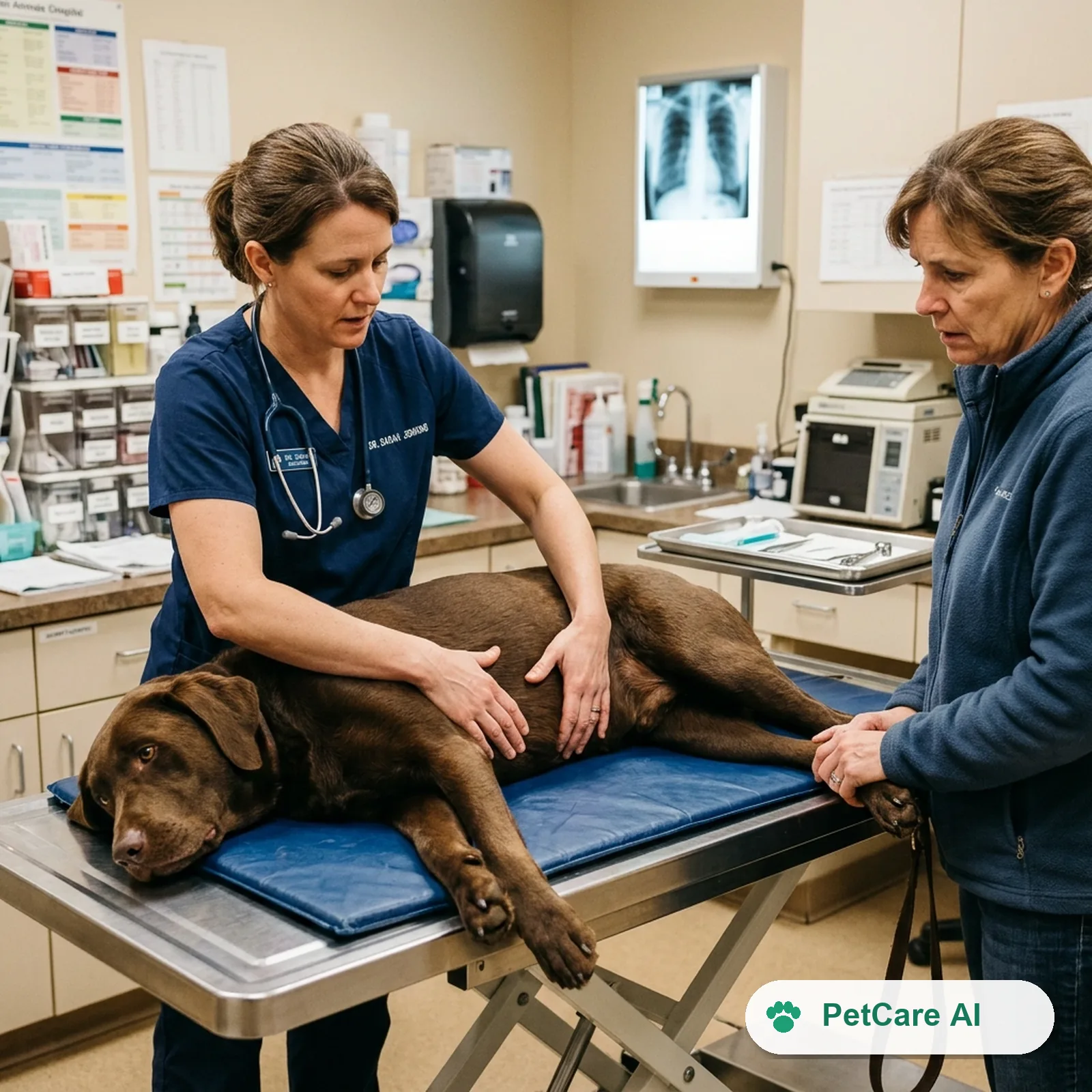
Your dog just threw up on the rug. Now you're standing there with a roll of paper towels in one hand and the car keys on the bench, trying to decide which one this is. Here's the honest answer most owners are looking for: dogs vomit reasonably often, and the majority of those episodes resolve themselves before you finish cleaning up. The minority that don't tend to give you specific signals — the colour and contents of what came up, the way your dog is behaving between vomits, and a handful of red-flag pictures every owner should be able to recognise. This guide walks through all three.

Most after-hours vomit episodes turn out to be nothing — but a few signs change the answer fast.
Why Dogs Vomit (and When It Usually Isn't Serious)
Vomiting is a defensive reflex. It's how a dog ejects something that shouldn't be in the stomach — grass, a chunk of bread crust, a parasite, a meal eaten too fast.1 An isolated vomit in a dog who is otherwise bright, eating, drinking, and behaving normally is almost always self-limiting.
The question worth asking isn't "did my dog vomit?" — it's "how is my dog between the vomits?" A dog who throws up once and then asks for dinner is in a very different category from one who throws up once and then lies down and won't move.
Two terms vets will ask about, so it helps to know which you saw:
- Vomiting is active — heaving, abdominal effort, partly digested food. Comes from the stomach.
- Regurgitation is passive — undigested food just falls back up, usually soon after eating. Comes from the oesophagus.
They have very different causes. If you can, note which one happened.
What the Colour of the Vomit Usually Means
Owners describe vomit by colour, so vets and triage tools think about it that way too. None of these are diagnostic on their own — but they sharpen the picture.
| What you see | Usually means | Urgency |
|---|---|---|
| Chunky, brown, smells like food | Recent meal coming back up — fast eating, mild stomach upset, grass | Low–Moderate |
| Yellow or green liquid (bile) | Empty stomach, often early morning. Common, rarely serious if isolated | Low if one-off; vet if recurring |
| Clear or white foam | Empty stomach + acid. Can also accompany kennel cough or — in deep-chested breeds with retching — early bloat | Moderate; Severe if retching unproductively |
| Bright red blood or pink streaks | Fresh bleeding — irritation, ulcer, foreign body, or in puppies possibly parvovirus | High to Severe |
| Dark brown, "coffee-ground" texture | Digested blood from higher in the GI tract | Severe |
| Black, tarry | Digested blood from further down, often serious | Severe |
| Worms visible | Parasitic infection — usually not an emergency, but needs treatment | Low–Moderate |
| Foreign material (string, fabric, plastic) | Possible obstruction. Linear foreign bodies (string, ribbon, floss) are surgical emergencies | Severe |
Yellow bile is the one owners worry about most — and the one they usually need to least. A dog who vomits a small puddle of yellow first thing in the morning, then eats breakfast normally, is almost always reacting to an empty stomach. If it's daily, that's a vet conversation — not a midnight one.
Coffee-ground vomit is the opposite — it looks less alarming than fresh red blood, but it's more concerning, not less. That texture means blood that has been sitting in the stomach long enough to be partly digested.
The Severity Ladder: Monitor, Same-Day, or Drive Now
Use this as a guide, not a substitute for a phone call.2
| Severity | Picture | What to do |
|---|---|---|
| Severe | Blood in vomit, distended/bloated abdomen, repeated unproductive retching ("dry heaving"), pale or grey gums, collapse, suspected poisoning or foreign body, can't keep water down | Drive to an emergency vet now. Don't wait for hotline advice. |
| High | Vomiting >24 hours, vomiting + diarrhoea + lethargy, puppy or senior dog vomiting at all, known toxin exposure even if currently bright | Same-day vet visit. Call ahead. |
| Moderate | Single isolated vomit, dog still bright and eating/drinking, no other symptoms | Monitor at home. Vet if not improving in 24 hours. |
| Low | Post-meal regurgitation in a known fast eater, single grass-induced vomit, otherwise normal behaviour | Watch and resume routine. A slow-feeder bowl often helps. |
Three Home Checks Before You Call the Vet
If you're unsure where on the ladder you sit, these three checks take ninety seconds and give the vet exactly what they need.
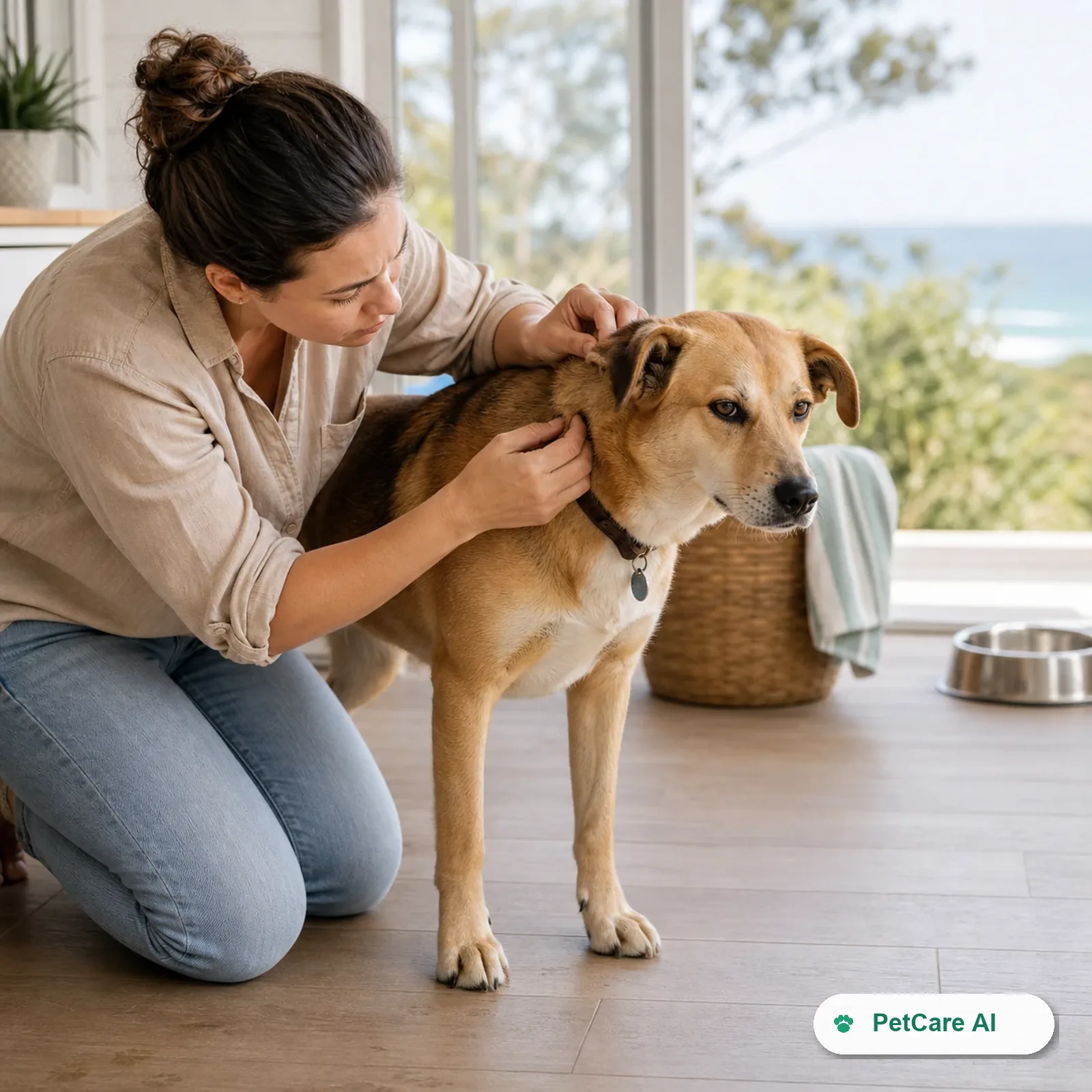
1. Gum colour and capillary refill. Lift your dog's lip. Healthy gums are bubble-gum pink and moist. Pale, white, grey, or brick-red gums are a red flag. Press a finger on the gum until it blanches — colour should return in under two seconds. Slower than that suggests poor circulation and warrants an immediate call.3
2. Hydration (skin tent test). Pinch the skin over the shoulders into a tent and let go. In a hydrated dog it snaps back instantly. If it sags or holds the tent, your dog is already dehydrated, which raises the urgency of any vomiting episode — particularly if they can't keep water down.
3. Abdominal shape. Look at your dog from above and from the side. Is the belly its normal shape? A drum-tight, swollen, or visibly distended abdomen — especially with unproductive retching — is a drive now sign. More on that next.
While you're checking, run through the last 24 hours: what did they eat? What might they have got into? Bin lid up? Compost reachable? Visitors with bags on the floor? Snail bait or rat bait in the shed? The history often matters more than the vomit itself.
 Deep-chested breeds — Great Danes, Weimaraners, Standard Poodles, German Shepherds — carry the highest GDV (bloat) risk and the lowest tolerance for "wait and see."
When the Rules Are Different: Bloat, Puppies, and Seniors
Three groups don't get the "single vomit, monitor at home" pathway. Knowing which group your dog is in changes everything.
Deep-chested breeds and bloat (GDV). If your dog is a Great Dane, Standard Poodle, Weimaraner, German Shepherd, Boxer, Doberman, Setter, or another deep-chested breed, and they're trying to vomit and nothing comes up ("dry heaving"), plus the abdomen looks or feels distended, treat it as a true emergency.4 Gastric dilatation-volvulus — bloat, where the stomach fills with gas and twists — can go from "off colour" to critical inside a couple of hours. Don't call the hotline first. Drive, and call the emergency vet from the car. The classic four signs:
- Repeated unproductive retching (gagging up nothing, or just foam)
- Visibly bloated, drum-tight abdomen
- Restlessness, pacing, unable to settle
- Excessive drooling
Puppies under six months. They dehydrate fast and have minimal energy reserves. A vomiting puppy who refuses food or water for more than a few hours can deteriorate quickly. Add diarrhoea and the situation can become serious within a day. Vomiting in an unvaccinated or part-vaccinated puppy also raises the spectre of parvovirus, which is endemic in parts of Australia and survives in the environment for months.5
Senior dogs (roughly 8+, breed-dependent). Older dogs often have underlying conditions — kidney disease, liver issues, endocrine disorders, neoplasia — that make any vomiting episode more meaningful. A senior dog vomiting "for no reason" deserves a same-day call rather than a 24-hour watch.
The Pictures That Mean Skip the Hotline and Just Drive
Some scenarios don't reward careful triage at home — the right move is to be on the way to an emergency vet while someone else dials ahead. If any of the following match your situation, treat it as that kind of moment:
- Your dog matches any of the Severe descriptors in the table above
- A deep-chested breed that is dry heaving, drooling, pacing, and visibly bloated
- A suspected toxin — chocolate, xylitol, grapes or raisins, snail or rat bait, onions or garlic, ibuprofen, paracetamol, antifreeze, lilies (cats), macadamia nuts
- A suspected foreign body, especially a linear one — string, ribbon, dental floss, fabric, fishing line. Linear foreign bodies are surgical emergencies even when the dog still seems fine
- A puppy under six months that has vomited more than once, or any vomiting puppy that won't drink
- A dog that can't keep water down for more than a few hours, regardless of age
When you're on the fence, the Animal Poisons Helpline (1300 869 738 in Australia) can resolve it in a single phone call — and they'll do it faster than a Google search will.
Honest Limits, Prevention, and AU Hotlines
Honest limits. Home checks tell you whether the situation is escalating, not what's wrong underneath. A dog with bright gums and good hydration can still have early pancreatitis, an undiagnosed obstruction, or a toxin still being absorbed. Home triage helps you avoid waiting too long; it doesn't replace a vet exam. PetCare AI's triage flow can sharpen the decision in 60 seconds — what kind of vomit, how often, what else is going on, breed, age, recent history. It will tell you whether you're looking at "monitor" or "go now," and what to ask the vet. It is not a substitute for the vet itself, and it will say so when the answer is "drive."
Prevention. Most non-emergency vomiting traces to a handful of avoidable patterns: scoffing food too fast (slow-feeder bowl), eating grass or compost (supervised toilet breaks), bin-diving (lidded bins), and being given fatty leftovers — pancreatitis loves a barbecue. Keep toxic foods well out of reach: chocolate, grapes and raisins, onions and garlic, macadamia nuts, anything with xylitol (sugar-free gum, some peanut butters, some baked goods). Keep current photos of your medication cabinet and any baits on your phone — when you call the hotline they'll ask, and a photo of the label is faster than a description.
AU hotlines worth saving in your phone tonight, not at 2am:
- Animal Poisons Helpline (Australia) — 1300 869 738 (free in standard hours, small fee after hours)
- Animal Poisons Helpline (New Zealand) — 0800 869 738
- Your regular vet during business hours — most clinics will triage by phone for free
- Your nearest 24-hour emergency vet — save the number under "Emergency Vet" now
Worried about your dog right now? Run a free 60-second triage with PetCare AI — describe what came up, the colour, how often, and what else you're seeing, and we'll tell you whether it's safe to monitor or time to drive.
Sources
Footnotes
-
Merck/MSD Veterinary Manual, Vomiting in Small Animals. https://www.merckvetmanual.com/digestive-system/diseases-of-the-stomach-and-intestines-in-small-animals/vomiting-in-small-animals ↩
-
VCA Animal Hospitals, Vomiting in Dogs. https://vcahospitals.com/know-your-pet/vomiting-in-dogs ↩
-
RSPCA Australia Knowledgebase, How can I tell if my pet is unwell? https://kb.rspca.org.au/knowledge-base/how-can-i-tell-if-my-pet-is-unwell/ ↩
-
Merck/MSD Veterinary Manual, Gastric Dilation and Volvulus in Small Animals. https://www.merckvetmanual.com/digestive-system/diseases-of-the-stomach-and-intestines-in-small-animals/gastric-dilation-and-volvulus-in-small-animals ↩
-
Australian Veterinary Association, Canine Parvovirus. https://www.ava.com.au/library-resources/other-resources/policies/canine-parvovirus/ ↩