How AI is Changing Pet Healthcare in Australia
From after-hours triage to early disease detection, artificial intelligence is quietly reshaping how Australians care for their pets — and the timing couldn't be more urgent.
 More than two-thirds of Australian households own at least one pet — and AI is quietly stepping in to help keep them healthy.
A Quiet Revolution in the Vet Clinic
Australia is a nation of pet lovers. According to Animal Medicines Australia, there are roughly 28.7 million pets in Australian homes, and 69% of households own at least one animal — one of the highest rates of pet ownership in the world.1 Yet behind the wagging tails and purring companions sits a system under genuine strain: rural vet shortages, rising consultation costs, after-hours emergencies, and waitlists that can stretch for weeks in some regions.2
Artificial intelligence is stepping into that gap — not to replace the trusted vet down the road, but to extend their reach, sharpen their tools, and put more information into the hands of pet owners before a problem becomes a crisis.
Here's how it's playing out across the country.
1. AI-Powered Symptom Triage at 2 a.m.
It's the scenario every pet owner dreads. Your dog is vomiting at midnight. The local clinic is closed. The nearest after-hours emergency vet is a 40-minute drive — and you're not sure if it's serious enough to warrant the trip.
This is where AI triage tools have found their first real foothold in Australia. By asking structured questions about symptoms, behaviour, and recent activity, an AI assistant can give pet owners a fast, evidence-based sense of whether they're dealing with something that can wait until morning, something that needs a phone call to a vet hotline, or something that requires immediate emergency care.
For owners in regional and rural Australia — where the closest emergency clinic might be hours away — that kind of decision support isn't a luxury. It's a genuine welfare improvement.
 After-hours symptom triage means most pet owners no longer have to guess between "wait until morning" and "drive to emergency."
2. Smarter Diagnostics Through Image Analysis
In veterinary clinics across Sydney, Melbourne, and Brisbane, AI is increasingly assisting with the interpretation of X-rays, ultrasounds, and pathology slides. Tools trained on large veterinary image datasets can flag potential abnormalities — a suspicious shadow on a chest X-ray, an unusual cell pattern in a blood smear — within seconds.
The vet still makes the call. But AI acts as a tireless second set of eyes, particularly valuable in general practice clinics that don't have an in-house radiologist or pathologist on staff. Peer-reviewed studies in human radiology have shown deep-learning models matching or exceeding specialist performance on narrowly defined tasks like detecting diabetic retinopathy or certain cancers,3 and veterinary applications are following the same trajectory.
For Australian clinics, that means faster turnaround, more confident diagnoses, and the ability to catch things that might otherwise slip through on a busy Saturday morning.
3. Bridging the Rural Divide with Telehealth
Australia's geography presents a unique challenge for veterinary care. A farmer in western New South Wales, or a family on a property outside Alice Springs, simply doesn't have the same access to veterinary expertise as someone in a metropolitan suburb. The Australian Veterinary Association has repeatedly flagged the shortage of rural and mixed-practice vets as one of the profession's most pressing issues.2
AI-augmented telehealth is closing that gap. Combined with structured symptom intake, photo and video analysis, and remote vet consultations, technology now allows owners in remote areas to:
- Get a preliminary assessment before driving hours to the nearest clinic
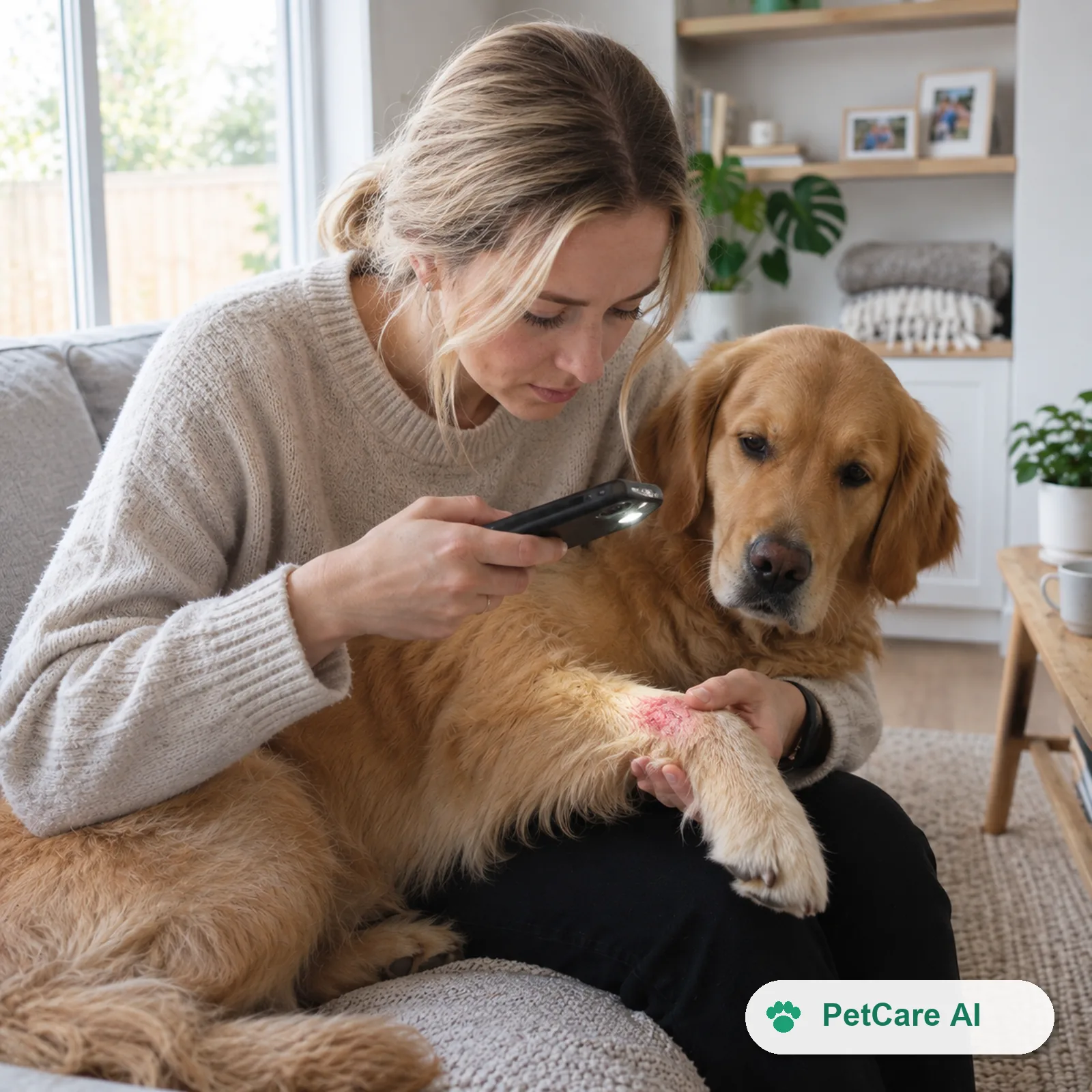
- Send images of skin conditions, wounds, or eye issues for analysis
- Continue post-surgery monitoring without unnecessary follow-up trips
- Access second opinions from specialist vets in capital cities
For working dogs, livestock guardian breeds, and rural pets, this represents a genuine shift in what care looks like outside the city.
 For pets living hours from the nearest clinic, AI-augmented telehealth is turning "when can we get there" into "right now."
4. Predictive Health Through Wearables
The same shift that transformed human health monitoring — Apple Watches detecting atrial fibrillation,4 Fitbits flagging unusual sleep patterns — is now arriving for pets. Smart collars and wearable devices track activity levels, heart rate, sleep quality, eating patterns, and even scratching frequency.
When AI analyses this data over time, it can spot early warning signs that even the most attentive owner might miss. A subtle decline in daily activity. Unusual sleep fragmentation. Changes in resting heart rate. These can be the earliest indicators of conditions like arthritis, heart disease, or chronic pain — often weeks or months before clinical symptoms become obvious.
For Australian pet owners, the implication is significant: catching problems early often means simpler, cheaper, and more successful treatment. A handful of pet insurers internationally have begun offering premium discounts for pets monitored through approved wearables, and the Australian market is expected to follow.
5. Lost Pet Recovery, Reimagined
Lost and surrendered pets remain a serious welfare issue in Australia. RSPCA shelters alone took in more than 111,000 animals in 2022–23, a substantial share of which were strays.5 Traditional microchipping helps when a lost pet is found and scanned, but it does little during the critical first 24 to 48 hours when most reunions actually happen.
AI is changing this in two ways. First, image-recognition tools can now match photos of found pets against databases of missing animals across community groups, council pounds, and rescue organisations. Second, smart QR-coded ID tags allow anyone with a smartphone to instantly contact the owner and share a live location — no scanner required.
Combined with AI-powered alerts to local Facebook groups and lost-pet registers, this dramatically shortens the window between "missing" and "found."
 Image-recognition matching and smart QR tags are shrinking the gap between "missing" and "found" from days to hours.
6. Easing the Pressure on Veterinary Practices
Australia is facing a well-documented vet workforce crisis. Burnout, long hours, and the emotional weight of the profession have led to record numbers of vets leaving practice, with the AVA describing the situation as a national workforce shortage.2 The clinics that remain are stretched thin.
AI is helping in less visible but equally important ways: automating clinical note-taking from voice recordings, summarising patient histories, drafting discharge instructions, suggesting differential diagnoses, and handling routine administrative work. Every hour an AI tool saves is an hour a vet can spend on patients — or on having a life outside the clinic.
This isn't about replacing veterinary expertise. It's about giving vets back the time and energy they need to do the work that actually requires their training.
The Honest Limitations
It's worth being clear about what AI in pet healthcare cannot do.
It can't physically examine your pet. It can't smell the distinctive sweetness of diabetic ketoacidosis on a dog's breath, feel a subtle abdominal mass, or notice that your cat just isn't quite right in the way an experienced vet can. It works best as a complement to professional care, not a substitute for it.
There are also legitimate questions about data privacy, the quality of training datasets (most are biased toward common breeds and conditions seen in North American or European clinics), and the risk of false reassurance. Any responsible AI tool should be transparent about its confidence levels and quick to recommend professional care when uncertainty is high.
The best implementations treat AI as a guide that helps owners ask better questions and act faster — not as an oracle.
What This Means for Australian Pet Owners
The picture emerging is one where technology and traditional veterinary care are becoming more intertwined, not less. Within five years, it's reasonable to expect that:
- Most pet owners will have an AI triage tool on their phone
- Wearable health monitoring for pets will be as common as it is for humans
- Telehealth consultations will be a standard part of routine care
- Vets will routinely use AI-assisted diagnostics in general practice
- Lost pet recovery will be measured in hours rather than days
For a country with Australia's geographic challenges, deep pet ownership culture, and pressured veterinary workforce, these aren't incremental improvements. They're a meaningful step toward better outcomes for pets and the people who love them.
 AI in the consult room won't replace the vet — but it gives them a sharper, faster set of tools to work with.
The Bottom Line
AI isn't going to replace your vet — and it shouldn't try to. But it's already changing what's possible between vet visits, in the moments when uncertainty hits hardest, and in the parts of Australia where professional care has always been hardest to reach.
The pet healthcare system of the next decade won't be defined by AI versus traditional veterinary care. It will be defined by how thoughtfully we combine the two.
For Australian pet owners, that future is already starting to arrive — one app, one wearable, and one early-detected illness at a time.
Curious how AI-powered pet healthcare could help you? Try PetCare AI for free — built right here in Australia, designed for the pets and the people who call it home.
Sources
Footnotes
-
Animal Medicines Australia, Pets in Australia: A national survey of pets and people (2022). https://animalmedicinesaustralia.org.au/report/pets-in-australia-a-national-survey-of-pets-and-people-2/ ↩
-
Australian Veterinary Association, Workforce strategy and rural vet shortage statements. https://www.ava.com.au/ ↩ ↩2 ↩3
-
Liu X. et al., A comparison of deep learning performance against health-care professionals in detecting diseases from medical imaging: a systematic review and meta-analysis, The Lancet Digital Health (2019). ↩
-
Perez M.V. et al., Large-scale assessment of a smartwatch to identify atrial fibrillation, New England Journal of Medicine (2019). ↩
-
RSPCA Australia, Annual Statistics 2022–23. https://www.rspca.org.au/facts/annual-statistics/ ↩